


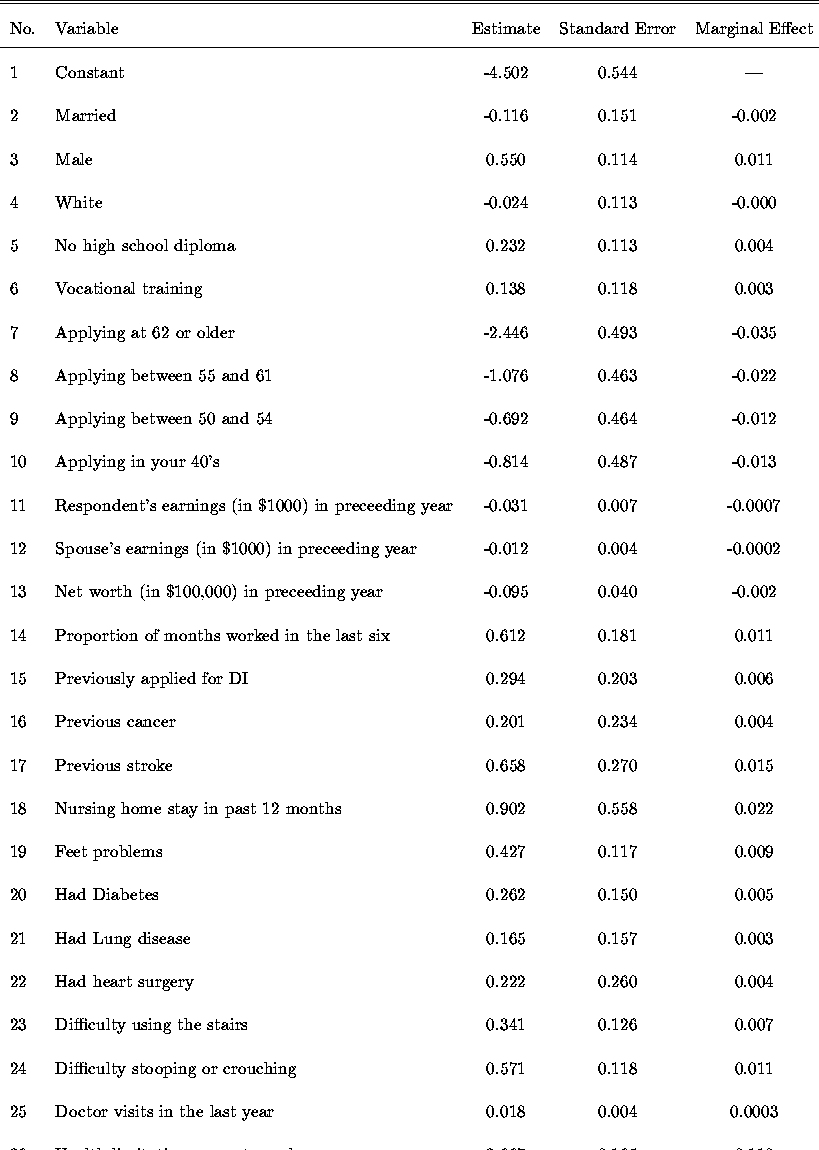
Table 4.1 presents results for a binary logit model of the DI application decision. All but one of the coefficients have intuitively plausible signs, although socio-economic variables such as race, sex, income, and wealth play a much less important role as predictors of the DI application decision once we condition on the health status measures. This result corroborates similar findings by Bound et al. (1995). One way to interpret this finding is that the health status variables are acting as approximate ``sufficient statistics'' in the sense that socio-economic differences in the propensity to apply for DI benefits manifest themselves primarily through the health status variables. A comparison of the characteristics of applicants and non-applicants reveal clear differences in health and socio-economic status. DI applicants are significantly less healthy than non-applicants in terms of both self-assessed health and disability as well as in terms of objective measures of health status and functional capacity. DI applicants are significantly economically disadvantaged relative to non-applicants in terms of education, income, and assets.
Of the health status variables the single most important variable
is HLIMPW, a
dummy variable that equals one if the individual reports having a health problem
that prevents them from working altogether, and zero otherwise. This variable
has the largest coefficient and the largest marginal effect on the application
probability. We interpret this as evidence of the importance of the individual's private
information about their ``true disability
status'' in the application decision. Although we find that
truly disabled individuals (i.e., those with
We interpret this as evidence of the importance of the individual's private
information about their ``true disability
status'' in the application decision. Although we find that
truly disabled individuals (i.e., those with 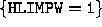 )
are substantially more likely to apply for DI benefits
than non-disabled individuals, self-selection is still relatively
far from generating a perfect ``separating equilibrium''
since over 30% of DI applicants in our sample
do not consider themselves disabled.
)
are substantially more likely to apply for DI benefits
than non-disabled individuals, self-selection is still relatively
far from generating a perfect ``separating equilibrium''
since over 30% of DI applicants in our sample
do not consider themselves disabled.
{
Table 4.1: Estimation Results for the Application Decision
}
Other variables that have significant effect on the application decision are age,
the applicant's income in the previous year, and the applicant's net worth. The
dummy variable for applying at age 62 or older shows that
individuals over age 62 are significantly less likely to apply for DI.
This seemingly counterintuitive result can be easily explained by the fact that 62 is the age
of first eligibility for early retirement benefits. Even
though DI benefits are more than 20% higher
than the early retirement benefits and DI beneficiaries qualify for
Medicare benefits sooner than early retirees, the delays and
uncertainties
involved in the DI application process constitute a sufficiently
great ``hassle cost'' to deter virtually all individuals over 62 from
applying. We interpret this
finding as clear evidence of opportunistic behavior in the DI
application decision.
Our estimation results also reveal that relatively younger individuals with low income and wealth levels are significantly more likely to apply for DI benefits. As we have shown in Section 4.1, an application for DI benefits involves significant delay costs and presumably other ``hassle costs'' as well. Therefore the individuals who stand to gain the most from incurring these costs are those who can expect relatively high replacement rates as well as those who are able to ``amortize'' the application costs over a relatively long time span. Given the progressive structure of the Social Security benefit formula described in Section 2, DI benefits can provide after-tax replacement rates in excess of 100% for those with the lowest earnings histories declining monotonically towards 0% replacement rates for those in the highest end of the income distribution. While low income individuals are also more likely to have physically demanding jobs and poor health, the fact that the income effect remains highly significant even after controlling for self-assessed disability is suggestive of problems of incentive compatibility in the DI benefit structure. The majority of the 30% of DI applicants in our data set who report not being disabled are in the lowest income decile: for this group the temptation to apply for DI benefits can be quite high.
Most of the other ``objective'' health and functional status indicators
and socio-demographic variables have the expected signs, although relatively
few are
highly significant. In particular we find that males and less-educated individuals (i.e.,
individuals with no high school diploma or only vocational training) are more
likely to apply for DI benefits. The model predicts that single and non-white
individuals are marginally more likely to apply for benefits, but the coefficient
estimates are not significant. As discussed above, the reason for this is that
most of the effects of race and marital status seem to be captured via the
HLIMPW indicator. If this indicator is excluded, then the race and education
variables become statistically significant.
In addition to the HLIMPW indicator, we also found self-rated health status indicators (variables 28-31) to be important predictors of DI application. A person who reports being non-disabled, but in poor health, is nearly 5 times as likely to apply for DI benefits as someone who reports being in excellent health.
In the HRS at least 80% of all individuals who reported filed an application for DI benefits by wave three. An analysis
of the characteristics of disabled individuals who chose not to apply for DI
benefits indicates that the majority are respondents who have income and assets
over the threshold limits for eligibility for SSI. This suggests that many of these
disabled non-applicants seemed to be aware of the SSI and SSDI eligibility
criteria and rationally chose not to submit applications in view of a high rejection
probability. Furthermore, relatively few eligible disabled individuals decide not
to apply for benefits.
Table 4.2 presents estimation results for the decision to appeal a denial. The table contains most of the variables included in our model of the application decision except for several variables (i.e., we combined respondent and spouse income into a single total family income variable, excluded the age dummies, and proportion of months worked in the last six) that were eliminated because they were insignificant or co-linear predictors of the appeal decision. It was more difficult to find significant predictors of the appeal decision because of the smaller sample size and the self-selected nature of the subsample of individuals who chose to appeal. Many applicants with the most disabling conditions (such as those who have ``listed impairments'' in the SSA Blue Book) were already awarded benefits in the first stage. Those who were rejected at the first stage are more likely to have less clear cut health impairments that may not necessarily prevent them from working.
The four most important predictors of the appeal decision are two
objective health status indicators (nursing home stay in the last 12 months and
an indicator for cancer), and two subjective measures (the HLIMPW
indicator and an indicator for excellent health).
Although it has a large standard error,
the nursing home indicator
has the largest estimated coefficient and thus the largest effect on the
appeal decision, raising the probability of an
appeal from 60% to over 90%. Having a health limitation that prevents work
raises the probability of an appeal by nearly 25 percentage points, and being in
excellent health reduces the probability of appeal by over 28 percentage points.
Most of the other objective health and functional indicators are statistically
insignificant predictors of the appeal decision. We interpret the strong impacts
of the subjective health status variables as evidence of the importance of
self-selection in the appeal process. In particular individuals who believe they are
truly disabled are significantly more likely to appeal an initial denial. For example,
while 68.8% of the individuals submitting an initial application for DI benefits
reported having a health limitation that prevents them from working, 76.8% of
those who were denied and chose to appeal reported .
Nevertheless, it appears that a fair number of truly disabled individuals are
discouraged from appealing their first stage rejections; of the 35% of rejected
applicants who chose not to appeal, 52.2% had .
Similar to our estimation results for the first stage application decision, we obtain the counter-intuitive result that the number of hours worked in the year prior to application is positively correlated with the appeal decision. This may simply indicate that most applicants suffer from sudden disabilities and not chronic conditions. Also, treatable conditions, such as high blood pressure, have a negative effect on the appeal probability.
{
Table 4.2: Estimation Results for the Appeal Decision
}